
Amy Kuo, Associate at Lund Opsahl, has been taking our TriMet Powell Base Electrification Project to the finish line, playing a key role late in design and construction administration. With the structure now complete and the project nearing overall completion, we sat down with her to reflect on her journey with the project, the lessons learned, and what it’s meant to help reshape a regional transit hub.
What do you like about transit projects?
I’m a heavy transit user and really believe in it, so it’s rewarding to work on projects that keep these systems running smoothly. It’s also been interesting because transit facilities are so different from typical buildings designed for people. These structures are built for buses and large vehicles, so the scale and the equipment we design around bring unique challenges and opportunities.
What excites you most about electrification and structural engineering’s role in shaping the future of transit infrastructure?
Electrification is fundamentally about reducing carbon emissions, which is the bigger mission we’re supporting. As structural engineers, we get to contribute by designing buildings that make this transition possible. For Powell Base, that means helping support the shift to electrified buses—which is in itself a relatively new program with lots to learn about. It’s exciting to be part of that change and to know our work directly supports a more sustainable future.
Were there any moments like unexpected site conditions or real-time coordination that required some creative problem-solving?
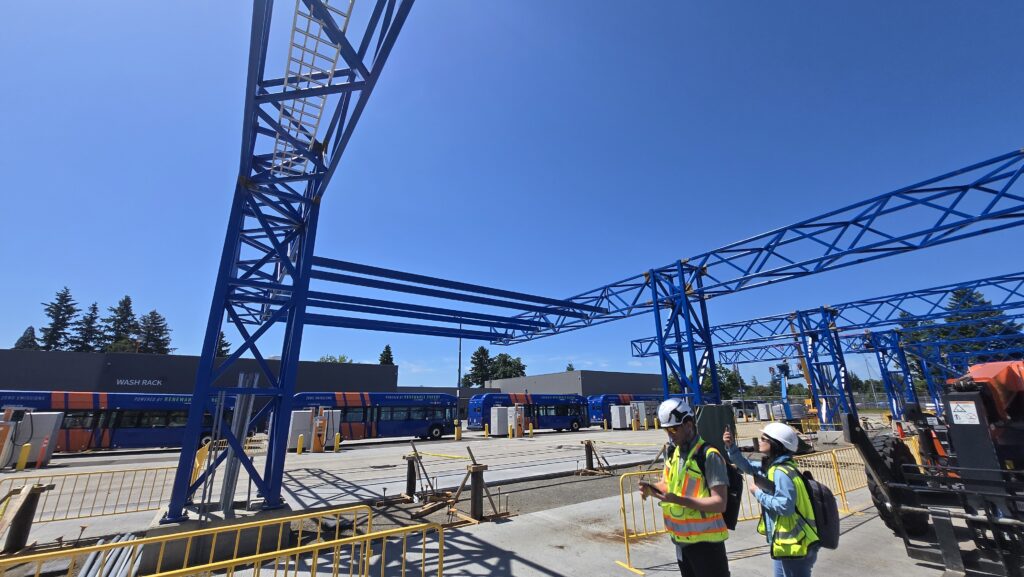
One of the trickier aspects of this project was the gantries—which are long structures with very tight clearances and tolerances. In the field, some of those connections were extremely tight. Rather than letting that slow progress, our team worked closely with the contractor to problem-solve in real time, finding creative ways to adjust details and keep installation moving forward. It reinforced for us how critical it is to build in extra tolerance during design, especially for large structures like gantries. That experience sharpened our approach and is something we’ve carried into subsequent projects to make construction more streamlined from the start.
Is there an aspect of the project you’re most proud of?
Just before issuing the final drawings, the team did an extensive review of the documents. That gave us the opportunity to incorporate lessons learned from earlier gantry projects, like the King County Metro Interim Base Electrification and South Annex Base. By frontloading that problem-solving, we were able to deliver a much cleaner set of drawings. As a result, construction required very few design changes or additional sketches. I’m proud that we were able to anticipate potential challenges early and set the project up for a smoother construction phase.
Amy Kuo
P.E., S.E., LEED AP BD+C
13 years of experience
Amy is passionate about creating innovative, beautiful, and meaningful additions to the built environment. With a background in both architecture and structures, she focuses on integrating structure for the benefit of the overall project. Beyond the buildings themselves, she finds joy in collaborating with great teams, continuously growing, and knowing there is always something new to learn.